
Quick answer: Define the first shipment, recipient opening and return journey separately. An ordinary peel-and-seal flap does not establish that a mailer can be reused for a return. Confirm the proposed closure format and evaluate the complete pack before approving it.

Map the two journeys
Describe what leaves the warehouse, what the recipient removes and what must come back. Include retail packaging and inserts that may be discarded. The return item can occupy a different amount of space or expose different edges once it has been opened.
Decide whether the same outer bag must be used again or whether a separate return package is acceptable. State that requirement in the enquiry. Do not ask for a generic resealable mailer and assume that every supplier understands the same return process.
Separate usable space from closure allowance
Prepare a drawing that identifies the usable bag area, flap and any reserved opening or sealing area. Review the item in its outbound and return arrangements. If the first opening removes part of the bag, confirm how much space remains for the intended return.
Ask the supplier to identify available constructions for the order. New Solution lists a self-adhesive peel-and-seal closure for its plain mailer family; a second closure strip or another return feature still needs order-specific confirmation. Illustrations in this guide show generic design questions, not available SKU commitments.
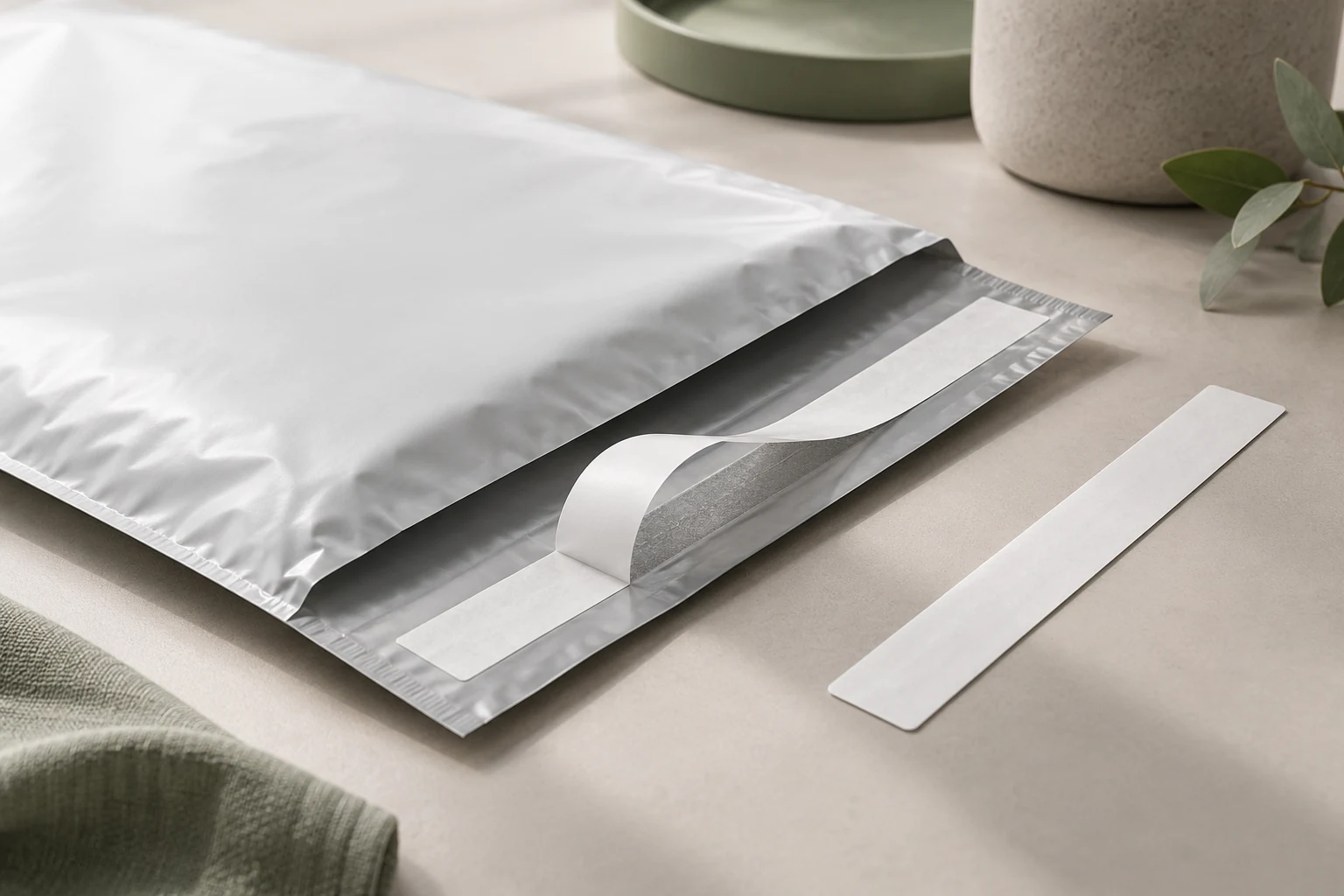
Trial opening, sealing and label placement
Use a representative sample and the actual packed item. Check insertion, sealing access, the recipient’s opening path and space for the return label. Record where a label, seam or opening feature conflicts with another part of the pack.
Keep the physical trial distinct from protection and closure-performance evaluation. An easy opening experience does not prove the package survives the intended route, and a visually intact flap does not establish an approved return closure. Agree the evaluation and acceptance conditions before the trial.
Review material and disposal wording
A return design may introduce a different adhesive, strip or other component. Match environmental documentation to the proposed finished construction rather than carrying a claim across from a simpler bag. BPI’s certification information distinguishes product assessment and labeling requirements; it is background for document review, not proof for a New Solution order.
Approve disposal wording and mark authorization with the final artwork. A second journey does not make a package universally reusable, recyclable or compostable. Confirm the supported claim and destination guidance separately.
Issue an approval record for the chosen design
- Outbound and return item arrangements.
- Usable dimensions before and after opening.
- Closure, opening feature and label positions.
- Sample and drawing revision references.
- Physical and shipment evaluation requirements.
- Finished-construction documentation and approved artwork.
- Quantity, destination and order-specific commercial terms.
Keep the selected sample with the signed-off drawing. Review a change in bag size, closure or return workflow before reusing that approval for another order.
Frequently Asked Questions
Does peel-and-seal mean return-ready?
No. Specify the return process and confirm a suitable design. The ordinary first-use closure does not establish a second-use arrangement.
Should the return item be measured again?
Yes. Review its actual return packing arrangement, especially if retail packaging or inserts are removed.
Can the same documentation cover a changed closure?
Ask whether the proposed finished construction remains within the stated scope. Do not assume a new strip or adhesive is covered.
Related Products and Guides
Read next: Plain Mailers vs Padded Mailers for Retail Shipping.
Read next: How to Check Finished-Bag Compostability Documents.
Read next: Custom Mailer Artwork and Print Approval: A Purchasing Checklist.
Discuss Your Packaging Specification
Sources
Published by New Solution. This guide supports preparation of a purchasing brief. Product claims and suitability are confirmed against the selected order specification and supporting documents.
Illustrations show generic packaging concepts, not verified product specifications.